Technical Documents
Specifications
Brand
United AutomationProduct Type
Driver Module
Mount Type
DIN Rail
Pin Count
9
Minimum Operating Temperature
0°C
Maximum Operating Temperature
65°C
Standards/Approvals
European Low Voltage Directive, EN61010-1, EN 50 081 part 2, European EMC Directive, EN61000-6-2
Series
DFMC36
Automotive Standard
No
Product Details
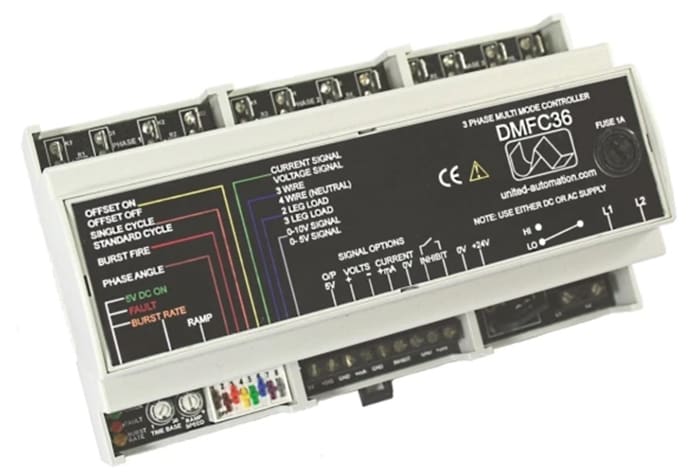
The DMFC-36 module has been designed to offer Phase-Angle or Burst Fire Control in firing a thyristor assembly or complete thyristor controller for driving resistive loads. In Single-Cycle or Dual-Cycle mode, these modules use the fastest burst rates possible, providing very accurate control and minimising Harmonic distortion & Flicker within the system.
The number of complete mains cycles during fixed repeating periods (typically 1 to 10 seconds) is varied, thus altering the duty cycle or on-/off-time ratio. Trigger pulses coincide with the zero-crossing times of the mains supply thus ensuring no RFI is produced when using resistive loads.

Ideate. Create. Collaborate
JOIN FOR FREE
No hidden fees!


Stock information temporarily unavailable.
€ 597.81
€ 597.81 Each (Exc. VAT)
€ 705.42
€ 705.42 Each (inc. VAT)
1
€ 597.81
€ 597.81 Each (Exc. VAT)
€ 705.42
€ 705.42 Each (inc. VAT)
Stock information temporarily unavailable.
1
| Quantity | Unit price |
|---|---|
| 1 - 2 | € 597.81 |
| 3+ | € 596.07 |
Ideate. Create. Collaborate
JOIN FOR FREE
No hidden fees!
Technical Documents
Specifications
Brand
United AutomationProduct Type
Driver Module
Mount Type
DIN Rail
Pin Count
9
Minimum Operating Temperature
0°C
Maximum Operating Temperature
65°C
Standards/Approvals
European Low Voltage Directive, EN61010-1, EN 50 081 part 2, European EMC Directive, EN61000-6-2
Series
DFMC36
Automotive Standard
No
Product Details
The DMFC-36 module has been designed to offer Phase-Angle or Burst Fire Control in firing a thyristor assembly or complete thyristor controller for driving resistive loads. In Single-Cycle or Dual-Cycle mode, these modules use the fastest burst rates possible, providing very accurate control and minimising Harmonic distortion & Flicker within the system.
The number of complete mains cycles during fixed repeating periods (typically 1 to 10 seconds) is varied, thus altering the duty cycle or on-/off-time ratio. Trigger pulses coincide with the zero-crossing times of the mains supply thus ensuring no RFI is produced when using resistive loads.
Ideate. Create. Collaborate
JOIN FOR FREE
No hidden fees!